
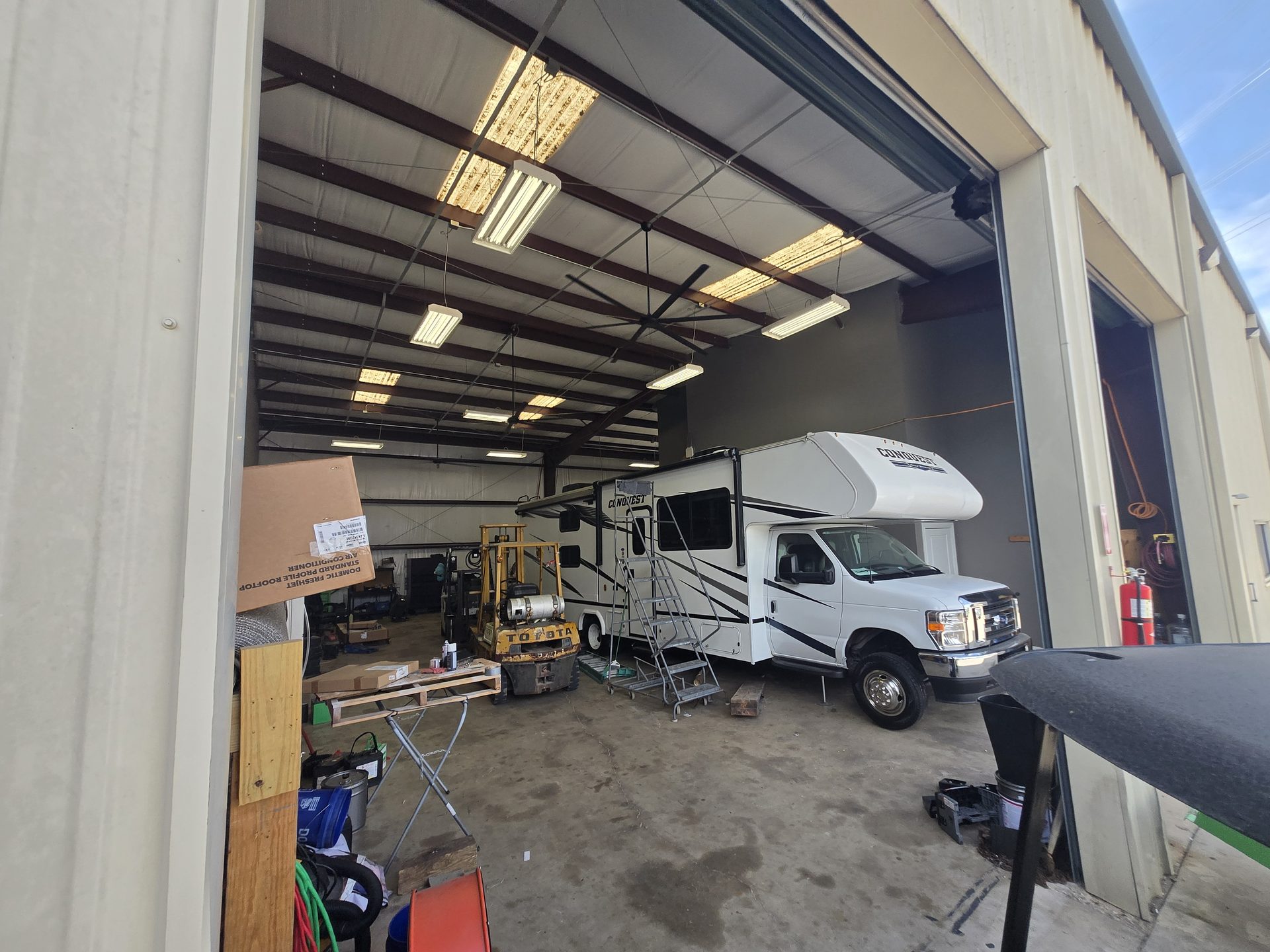
If you walk your RV roof and one section gives under your weight, that is not a maintenance item you can put off until the next trip. A soft spot means water has already been inside the roof structure long enough to break down what sits under the membrane. The question is no longer whether there is damage. It is how far it has travelled.
We see this constantly in Spring and across the Houston area, and the reason is not a mystery. Heat, sun and rain in the same week, over and over, for years.
What is actually happening under the membrane
Most RV roofs are a sandwich. A rubber or fiberglass membrane on top, a thin layer of decking under that, then the framing, then your interior ceiling. The membrane is the only waterproof part. Everything below it is designed to stay dry.
Water almost never comes through the middle of a membrane. It comes in at the edges of things: the air conditioner shroud, vents, skylights, antenna bases, the seams along the sides, and the sealant that was run around every one of those when the coach was built. That sealant is a consumable. It dries, it shrinks and it cracks, and in Texas sun it does all three faster than the brochure suggested.
Once water gets past it, it sits on the decking. Decking that stays wet delaminates and rots. When enough of it has gone soft, you feel it through your boot.
Why Houston is hard on roofs
Heat cycling. A dark roof in a Spring parking lot can swing more than sixty degrees between two in the afternoon and four in the morning. Every one of those cycles expands and contracts the sealant beds. That is what opens the cracks.
Humidity. In a dry climate a small leak dries out between rains. Here it usually does not. Wet decking stays wet, and wet decking rots on a schedule.
Storage under trees. Shade feels like a kindness and is the opposite. Leaf litter holds moisture against the membrane and branches score it. If your coach lives under an oak between trips, check the roof more often, not less.
The difference between a repair and a rebuild
This is the part owners want a straight answer on, so here it is in plain terms.
Sealant maintenance. No soft spots, sealant just looking tired and cracked. Clean the old beds, reseal every penetration and seam. This is the cheapest day you will ever spend on your roof and it is the one that prevents everything below.
Localized decking repair. One soft area, usually around a vent or the air conditioner. We open the membrane over the affected section, cut out the wet decking, replace it and reseal. Done properly, the patch is not a weak point.
Partial or full roof replacement. Multiple soft areas, or one large one, or soft edges running along a seam. At this point patching is throwing money at a roof that will fail again somewhere else.
Structural work. Soft spots at the corners, sagging ceiling panels inside, or delamination showing on the sidewalls. Water has reached the framing. That is body repair, not roof repair, and it is the expensive end.
Nobody can tell you which of those you are in without getting on the roof. That is not a sales line. It is the actual reason we do not quote roofs over the phone.
What we look for on an inspection
We offer free RV roof inspections, and what that means in practice is a technician walking the roof and checking, in order:
- Every penetration: air conditioner, vents, fans, skylights, antennas, refrigerator vent
- Every seam along the front cap, rear cap and both sides
- The condition and adhesion of the existing sealant, not just whether it is present
- Soft or spongy areas underfoot, and where their edges are
- The interior ceiling and upper cabinets for stains, which tell you where water has already been
- Previous repairs, because a bad patch is often the source of a new leak
You get told what we found, what it needs and what it will cost, before anything is booked.
Signs you should not wait on
- Any give underfoot on the roof
- A stain on the interior ceiling, even an old one you think has dried out
- A musty smell after rain
- Sealant you can lift with a fingernail
- Nail heads or screw heads standing proud of the roof surface
- A ceiling panel that has started to sag or separate
A single soft spot caught early is often a one-day job. The same spot next spring can be a roof.
If it was a storm, it may be a claim
If the damage started with hail or a branch rather than with age, it is usually an insurance matter and not a maintenance one. We write an RV insurance claim estimate and work directly with adjusters, so the paperwork does not land on you. That is worth knowing before you pay for a roof out of pocket.
Booking
Call (346) 708-4612 or use the contact form. We are open Monday to Friday, 7:00am to 4:00pm, at 21619 Rhodes Rd in Spring. Tell us what you have found and roughly how old the coach is, and we can usually tell you on the phone whether you are looking at a sealant day or something bigger.